


Government intervention in the UK steel market is beginning to change the cost and risk environment for construction. British Steel’s nationalisation, new trade measures, carbon-border policy and greater scrutiny of steel origin in public procurement may all influence pricing, availability and sourcing decisions. For clients, this makes early consideration of steel procurement, supply chain exposure and specification increasingly important to maintaining cost and programme certainty.
The immediate implication is not that every steel package requires a blanket uplift. The first effects are more likely to appear through shorter quote validity, origin qualifications, exclusions, wider price dispersion and changes in risk allocation. Exposure will vary by product, source, import timing and contract position, so the appropriate response is package-level analysis and earlier sourcing decisions rather than a generic materials contingency.
What Has Changed - And Why It Matters
On 16 July 2026, British Steel was brought into public ownership. Nationalisation will not, by itself, add a percentage point to the cost of a steel frame. But it is the clearest signal yet that the market in which UK construction buys its materials is being reshaped by government policy, trade protection and strategic concerns.
British Steel’s nationalisation[1] and the new quota-and-tariff regime[2] serve different purposes. The trade measure forms part of the policy programme set out in the UK Steel Strategy, while public ownership followed a separate judgement that British Steel’s strategic capability needed to be secured. Their relationship is therefore strategic rather than causal: one changes the wider market in which UK producers compete, the other preserves a strategically important producer.
Two weeks before nationalisation, the Government’s new steel trade measure came into force. Overall tariff-free import quotas were reduced by 51% compared with the previous safeguard regime, with a 50% tariff applying to imports outside quota. The Government had initially announced a 60% reduction - the final measure, published after industry and EU engagement, reduced quotas by 51% and applies only to steel products that can be made in the UK.[3]
From January 2027, the UK Carbon Border Adjustment Mechanism, or CBAM, will place a carbon price on specified imports from several sectors, including iron and steel, aluminium and cement. Updated central government procurement guidance is also making steel origin more visible in government contracts.
The Government is seeking greater industrial resilience. Construction will share both the cost and, if the policy succeeds, the benefit. The result is a new component of construction cost and risk - the sovereignty premium.
Inflation Without a Hot Market
The new policy regime is taking effect in a weak construction market. That matters because competitive conditions should temper the pass-through of additional costs – but they will not make policy exposure disappear.
The S&P Global UK Construction PMI remained deeply contractionary in June, with further sharp falls in output and new orders.[4] Yet weaker workloads are not translating into across the board materials price relief. The Department for Business and Trade’s all-work materials index was 5.4% higher in May 2026 than a year earlier. Between February and May, the producer-price indices for fabricated structural steel and reinforcing bar rose by 11.1% and 7.5% respectively, while cement fell by 1.0%.[5]
These figures pre-date the new July quota regime and cannot be used as evidence that the policy has already raised prices. Recent steel price movements also reflect energy, logistics and geopolitical pressures. They are also producer price indices – not stockholder quotations or project tender rates. They show pressure emerging upstream, but not how much has passed through the distribution and contracting chain.
In a weak and competitive market, existing stock positions, spare capacity and margin compression may delay or absorb some of that cost pressure. The initial effects of the new policy regime may therefore become more visible through changing commercial conditions than through an immediate and uniform increase in benchmark tender prices.
How Industrial Policy Reaches a Tender
The earliest evidence may not be a dramatic movement in a published benchmark. Policy risk often enters tenders first through commercial behaviour:
shorter quote validity and wider exclusions
quota, origin and commodity-code qualifications
higher risk allowances or advance-payment requests
earlier purchasing, stockholding or alternative sourcing
additional carbon, provenance and reporting requirements
This matters because cost plans generally observe rates more easily than they observe changing conditions attached to those rates. A quote can remain numerically stable while becoming less valuable if its validity shrinks, exclusions widen or the client inherits more of the policy risk.
For new relevant steel procurements commencing from 1 October 2026, in-scope organisations are expected to confirm whether UK-produced steel will be used. The measure applies to projects or programmes valued at £10m or more or expected to require more than 500 tonnes of steel, with a rationale required where origin is non-UK, mixed or unknown.[6]
The guidance does not mandate UK steel, and procurement law still constrains unjustified discrimination. Its effect is subtler - steel origin is becoming a formal input into design, assurance and reporting rather than an incidental detail discovered after award. Once origin is visible, clients can assess its implications for embodied carbon, compliance, supply-chain resilience and programme risk. In practice, this could shift demand towards products with clearer provenance and lower perceived supply-chain risk, even without an explicit preference for UK steel.
G&T’s forthcoming Steel Market Pulse survey[7] will provide an early indication of whether changing market and policy conditions are beginning to appear in benchmark rates, lead times and near-term pricing expectations. By tracking standard structural-section supply-only rates separately from fabricated steelwork package rates, it should help identify where cost pressure is emerging along the supply chain.
Why Steel Will Not Move as One Market
The new trade regime is significant, but its effects will vary by product, origin, timing and contract position.
For covered products, the 50% tariff does not apply to every tonne imported. It applies to imports outside the relevant quarterly quota and is charged on the value of the covered imported good – not automatically on the full value of the eventual fabricated-and-erected package.
Worked Example: How an Out-of-Quota Tariff Could Affect a Package
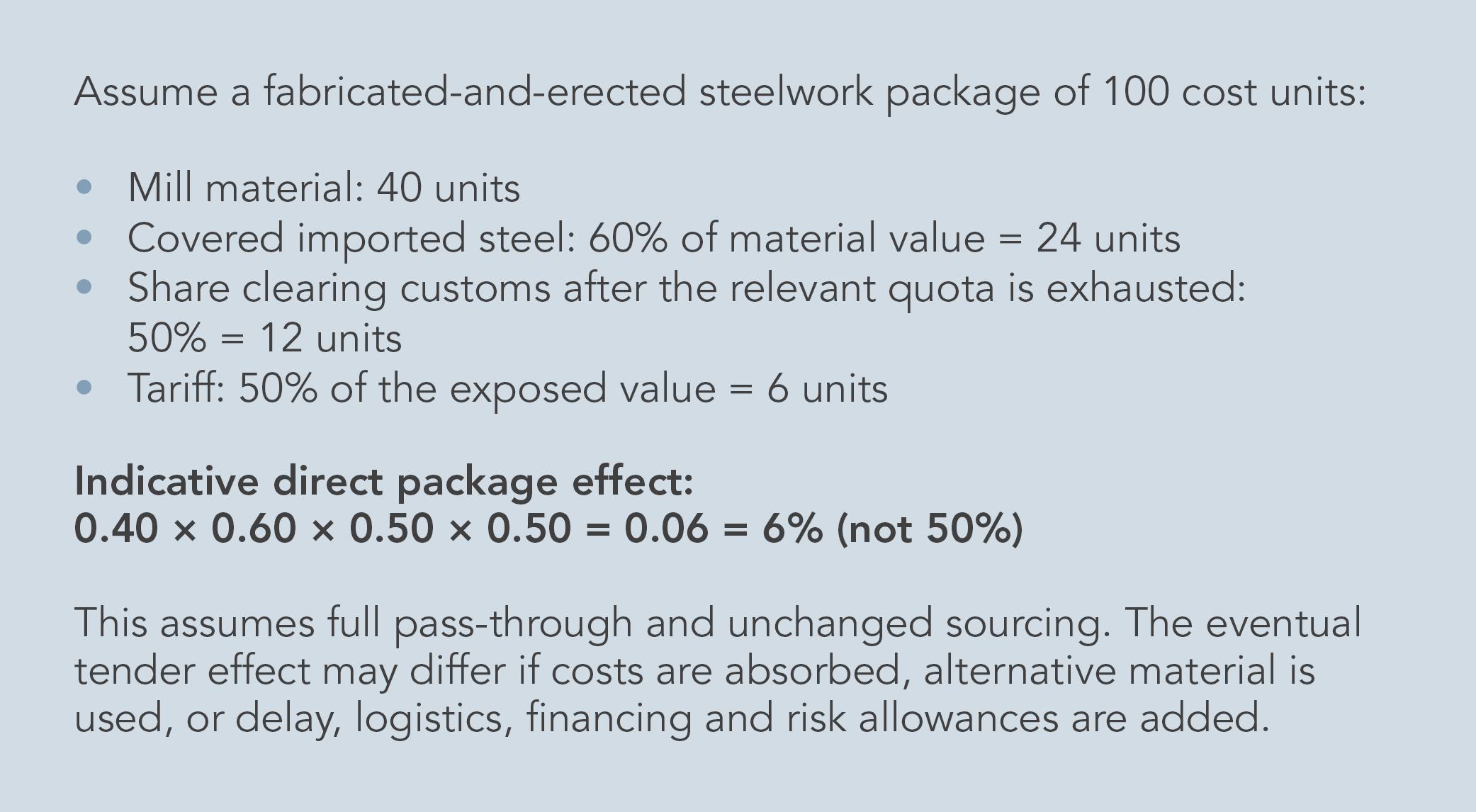
Quotas are managed by product category and, in some cases, by country or territory of origin, with access granted on a first-come, first-served basis and unused volumes able to roll into the following quarter within the same quota year. A transitional exemption also applies until 30 September 2026 to relevant goods imported under contracts entered into before 14 March 2026.[8]
Project exposure will therefore depend on four broad variables:
whether the product is covered
its origin and quota position at the expected import date
the availability of existing stock or substitute sources
the share of the package value represented by the affected material.
The 13.1% rise in the fabricated structural steel materials price index in the year to May 2026, alongside a 1.2% fall in reinforcement over the same period, already illustrates the danger of treating “steel” as a single cost input.[9] The new trade regime is likely to add to that differentiation rather than remove it.
The way carbon costs are measured and reported will also differ between imported and domestically produced steel.[10]
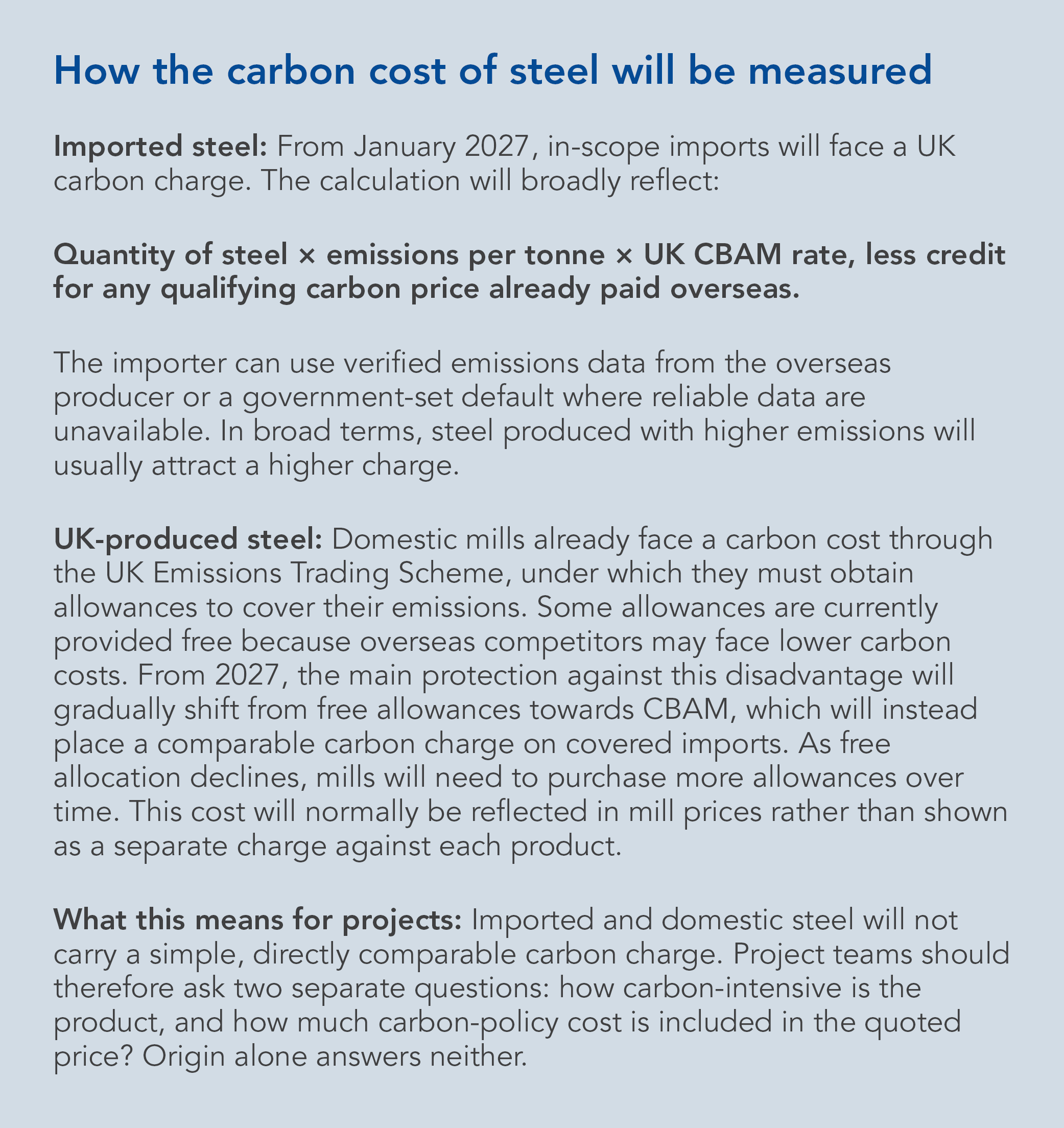
CBAM will not automatically favour every domestic product. Its commercial effect will depend on emissions intensity, production route, origin and the quality of supporting data. The more defensible expectation is not that “steel rises by X%”, but that price dispersion, contractual qualifications and scrutiny of provenance will increase.
The Sovreignty Premium: Balancing Cost and Resilience
For much of the past three decades, UK clients benefited from a “globalisation discount” - access to the cheapest compliant steel available internationally. But those prices were never produced by a pristine free market - state support, energy subsidies, trade defence and global overcapacity all played a part. Global sourcing was rational for individual projects, while at economy level it contributed to the erosion of domestic capacity and transferred some risk from the purchase price into exposure to plant closures, trade disputes and disruption.
UK crude steel production has fallen by more than half over the past decade. In 2024, domestic production met only 30% of UK steel demand, compared with a share typically between 40% and 50% during 2010–20.[11] The Steel Strategy aims to return domestic production to around 40–50% of demand and provides for up to £2.5bn of support to rebuild and modernise the sector.[12]
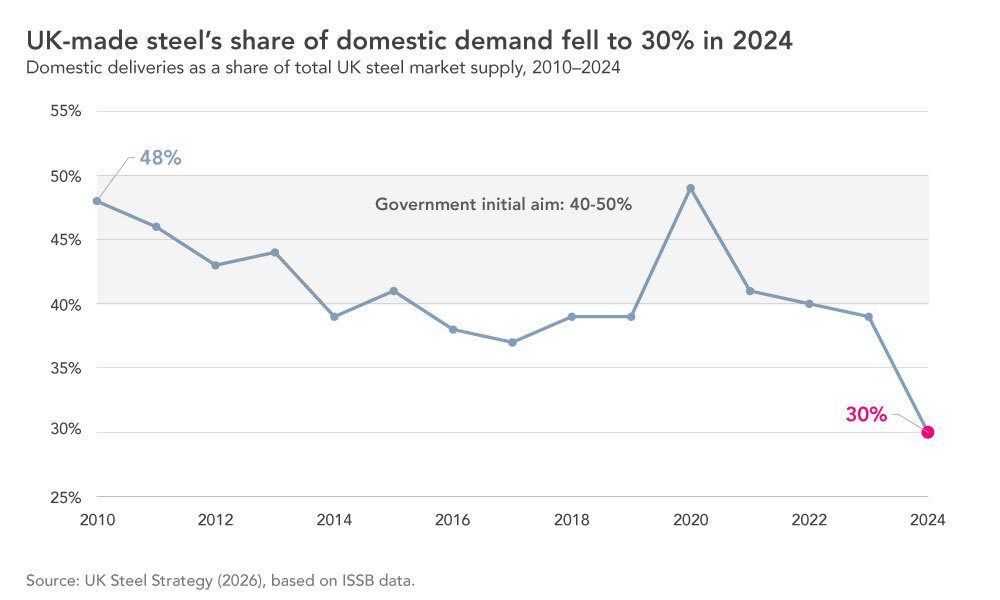
Figure 1: Domestic producers supplied 30% of the UK steel market in 2024, down from 48% in 2010. The Government’s initial aim is to return the share to the 40–50% range sustained during much of 2010–20.
The challenge is not simply to restore lost output. Total steel demand is expected to rise from 9.1 Mt in 2025 to 11.2 Mt in 2030 – an increase of 23%.[13] Demand for sections – particularly relevant to construction – is forecast to increase from 1.2 million tonnes to 2.0 million tonnes, while the Government’s own assessment identifies significant domestic capacity gaps in that category.[14]
The issue is therefore not only how many tonnes the UK can make, but whether it can make the right tonnes at the point they are needed.
The objective is not self-sufficiency - even if the target is achieved, imports will remain indispensable. It is better understood as an attempt to reduce reliance on global supply and create a more deliberately balanced mix of domestic production and imports.
The relevant comparison is therefore not “cheap imports” versus “expensive sovereignty”. It is the visible cost of greater resilience versus the less visible expected cost of disruption under the previous global sourcing model.
The sovereignty premium should not be understood as a single percentage applied to every steel package. It reflects the additional cost of lower tariff-free quotas, out-of-quota duty risk, carbon compliance, transition investment and constrained competition, offset by public support, productivity gains, shorter logistics chains and greater supply assurance. If policy creates modern, competitive capacity rather than simply sheltering existing production, part of the initial premium could diminish over time.
That is the crucial policy test. Public ownership of one producer does not create resilience by itself - it also requires sufficient capacity, the right product range, reliable energy and raw materials, investment, skills, stockholding and an appropriate degree of redundancy. Any higher cost will be justified only if it produces a measurable resilience dividend.
Beyond Steel
The same principle applies beyond steel. From 1 January 2027, CBAM will create carbon-related cost and compliance exposure for specified imports of aluminium and cement. Electrical equipment may also be affected indirectly through its steel and aluminium inputs. The impact will vary by product, source, emissions data, market capacity and timing. Project teams should therefore assess the relevant package rather than assume a uniform materials uplift.
G&T can help clients assess these exposures at package and project level, test sourcing assumptions and translate policy change into proportionate cost and procurement advice.
What This Means for Project Teams
Clients should resist the apparent safety of a blanket “steel uplift” or general materials contingency. It is simple, but risks overpricing unaffected packages while under-providing for those with genuine exposure.
A more defensible approach is to:
- Assess exposure at package level. Identify likely product origin, commodity code, quota position, expected import date, importer of record, CBAM scope, domestic alternatives and any applicable procurement requirements.
- Unbundle and interrogate the rate. Separate mill material from fabrication, labour, coatings, logistics, erection, overhead and margin. Record quote validity, exclusions, origin qualifications and other commercial conditions alongside the headline price.
- Use scenarios rather than a single uplift. Compare domestic sourcing, in-quota and out-of-quota imports, and alternative origins or specifications, including the implications for programme, redesign, approval and performance.
- Fix the sourcing and contractual position earlier. Where exposure is material, early supplier engagement, clearer origin data and timely purchasing may offer better protection than a larger contingency added later. Contracts should also define responsibility for policy-related costs, emissions and origin information, quota unavailability, changes in law and proposed substitutions.
- Test what any premium actually buys. Greater resilience may justify a higher first cost where it demonstrably provides stronger supply assurance, programme protection, carbon performance or price certainty. Domestic origin alone should not be treated as proof of those benefits.
British Steel’s nationalisation is the immediate news hook, but the more important point for project teams is that government policy is playing a greater role in shaping construction costs and supply decisions. Workload, wages, commodities, energy and capacity still matter, but tariffs, carbon costs, sourcing rules and industrial support now need to be considered alongside them.
Steel may not be the end of this story. The Burnham government has signalled stronger public control of essential services and greater use of public procurement to support British industry. If those ambitions are translated into policy, similar questions of cost, capacity and resilience could arise across a wider range of construction markets.
In practical terms, the state is becoming a more visible part of the cost plan – and its effects will need to be assessed project by project.
References
[1] https://www.gov.uk/government/news/government-brings-british-steel-into-public-ownership-to-protect-uk-steelmaking
[2] https://www.gov.uk/government/publications/uks-steel-trade-measure-from-1-july-2026/uks-steel-trade-measure-from-1-july-2026
[3] https://www.gov.uk/government/publications/uks-steel-trade-measure-from-1-july-2026/uks-steel-trade-measure-from-1-july-2026?
[4] https://www.pmi.spglobal.com/Public/Release/PressReleases
[5] https://www.gov.uk/government/collections/building-materials-and-components-monthly-statistics-2012#2026-monthly-bulletins
[6] https://www.gov.uk/government/publications/ppn-022-procuring-steel-in-government-contracts/ppn-022-procuring-steel-in-government-contracts-html
[7] G&T’s Steel Market Pulse is currently in development and is intended to provide a recurring, evidence-led view of structural steel pricing, lead times and near-term market direction. It will draw on feedback from fabricators, stockholders, distributors and producers, with the first survey expected to launch later in 2026.
[8] https://www.gov.uk/government/publications/uks-steel-trade-measure-from-1-july-2026/uks-steel-trade-measure-from-1-july-2026?
[9] https://www.gov.uk/government/collections/building-materials-and-components-monthly-statistics-2012#2026-monthly-bulletins
[10] https://www.gov.uk/government/publications/carbon-border-adjustment-mechanism-cbam-policy-summary/carbon-border-adjustment-mechanism-cbam-policy-summary
[11] https://www.gov.uk/government/publications/steel-strategy/the-uk-steel-strategy-web-version
[13] https://www.gov.uk/government/publications/uk-steel-strategy-demand-assessment


