


Universities are investing more carefully in their estates than at any point in a generation. With tuition fee income constrained, international student recruitment under pressure and construction costs still elevated, institutions that once maintained ambitious capital pipelines are now making harder choices about what actually gets built.
The scale of that shift is significant. The Association of University Directors of Estates (AUDE) reports that total capital expenditure across the sector remains stuck at £2.5bn annually, compared with a pre-pandemic high of £3.5bn in 2019. In nominal terms, that is a fall of almost 30%. Adjusted for construction inflation, the reduction is likely closer to 45%, meaning universities are now investing far less in real terms than the headline figures suggest.
The result is not paralysis, but selectivity. Universities are still investing, but with greater scrutiny, clearer business cases and a stronger focus on outcomes. The estate is increasingly being judged not just by its scale or condition, but by how effectively it supports student experience, research performance, operational resilience and the university’s long-term financial and environmental commitments.
The universities best placed to navigate this environment will not necessarily be those with the largest capital programmes, but those making the clearest estate decisions: prioritising the right projects, making existing assets work harder, and linking investment directly to student outcomes, research strength, income generation and operational resilience.
As Chris Boyce, partner at G&T, explains: “The challenge our university clients are facing is not simply whether they can afford to invest. It is deciding where limited capital will have the greatest impact, when to commit, and how to understand the long-term value those decisions will create.”
G&T’s work across higher education estates combines long-standing sector experience with live cost, programme and procurement insight from active campus, teaching, research and refurbishment projects. In a market where capital is more constrained and every investment decision is subject to greater scrutiny, this helps institutions test options early, prioritise limited funding and create spaces that support students, research and long-term estate performance. Through G&T’s Smart Data capability, we can also help clients use estate, cost and programme data to compare scenarios, understand trade-offs and make decisions with greater confidence. The projects and observations that follow show what this means in practice.
Prioritising spend in a constrained market
For many universities, estate strategies that were developed in a more optimistic funding environment are now being reassessed. This does not mean ambition has reduced. It means decisions are being tested more rigorously. Projects that might once have been justified by growth, reputation or long-term aspiration now need to demonstrate a clearer and more immediate link to student outcomes, research priorities, income generation and operational performance, from better utilisation to lower running costs and carbon reduction.
That shift is changing the role of early-stage advice. Cost, value, programme, risk and long-term performance need to be understood before commitments are made, not once a preferred solution has already gathered momentum. In this environment, the most valuable decisions are often the ones that happen before a project becomes a project.
WH Stephens, a Gardiner & Theobald company, worked on Ulster University’s Belfast Campus which shows how estate investment can support wider institutional and civic objectives. One major phase of the York Street development delivered new interconnected academic buildings, consolidating teaching, research, library, student support and social facilities within a modern urban campus. Delivered on a constrained live city-centre site, the project required careful cost control, coordination of complex building packages and management of existing-building interfaces, logistics and public-realm constraints. It demonstrates how higher education investment can create long-term value when campus strategy, delivery discipline and civic purpose are aligned.
Across G&T’s higher education work, that clarity of purpose is the common thread. At Ulster University, the focus was consolidation, capacity and civic value. At Teesside University’s Digital Life Building, estate investment is directly aligned to academic and research priorities. Elsewhere, smaller interventions across existing campuses are helping institutions improve student experience, unlock better utilisation and extend the value of assets already in use.
Creating high-impact student spaces
Student expectations have not diminished because institutional budgets are under pressure. If anything, the link between estate quality and student experience has become more important in a competitive student recruitment market.
Universities are therefore looking beyond major new buildings to the spaces students use every day: social areas, informal learning environments, receptions, entrances, libraries, outdoor spaces and the public realm between buildings. Quality in this context is defined less by architectural statement and more by performance: whether spaces are welcoming, accessible, flexible, well used, sustainable to operate and supportive of wellbeing, belonging and day-to-day student life. These are the spaces that shape how students experience the campus, and how prospective students and their families judge the institution.
At University College London, investment in the Bloomsbury Main Quad has shown how external spaces can play a significant role in improving the student experience. By turning underused areas into high-quality, welcoming environments, the university has created visible impact without relying solely on major new construction. The lesson is particularly relevant in the current market: the spaces between buildings can be as important to campus quality as the buildings themselves. Where public realm, social space and informal learning environments are well designed, they can strengthen students’ sense of belonging, improve day-to-day experience and support the wider appeal of the institution.
A similar principle can be seen at the University of Leeds, where a £32m campus improvement programme was delivered across 25 projects. Rather than waiting for a single major redevelopment, the programme focused high impact, quick win projects to social spaces, receptions, building entrances and the areas most visible to students and visitors. One such project was Health Science Library which created a more flexible and student-centred learning environment, supporting changing patterns of study, wellbeing and user experience without requiring wholesale redevelopment. It demonstrates how targeted investment in the right asset can deliver a significant improvement in campus quality.
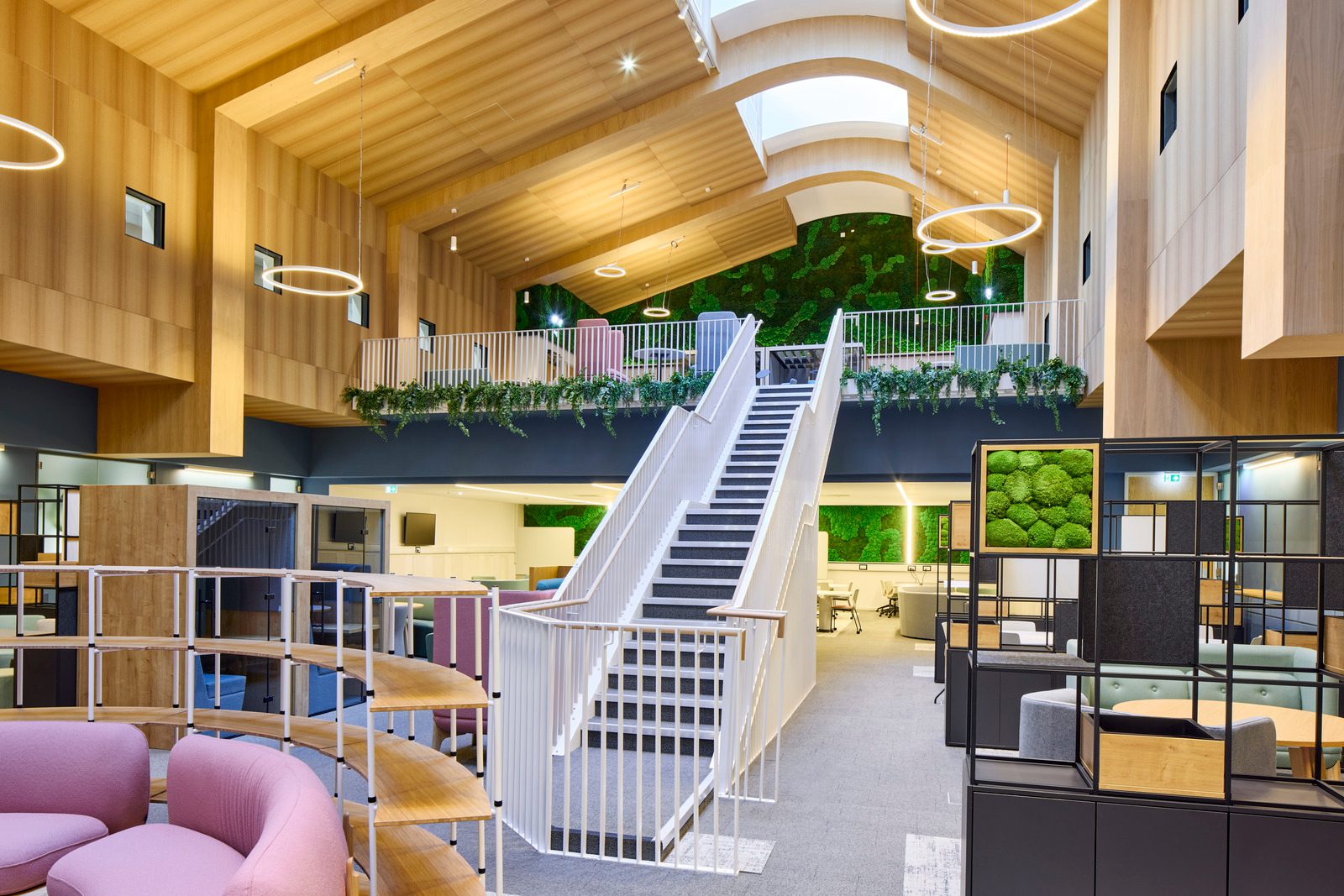
University of Leeds - Health Science Library
Ben Walker, partner at G&T, describes this as a shift towards “High-impact, high-performing space that does not always have to be large-scale”. He adds: “In the current market, universities are looking for interventions that work harder. That might be a social space, a landscape improvement or a better arrival experience. The point is that it must create value for students and staff, and attract new students, not just add more space.”
Supporting employability and changing models of learning
The estate also has an important role to play in supporting employability. For many students, the value of higher education is increasingly linked to career outcomes, industry exposure and the ability to develop practical, transferable skills.
This is changing the types of spaces universities need. Alongside teaching environments, institutions are investing in spaces for collaboration, careers activity, enterprise, mentoring and professional development. These are not always conventional academic spaces, but they are central to how universities support student outcomes.
The University of Westminster’s Centre of Employability and Enterprise is a clear example of this direction. Rather than acting as a traditional teaching building, it supports students in developing professional skills and connections with employers. It reflects a broader shift in which curriculum strategy, student experience and estate strategy are becoming more closely aligned.
For universities seeking stronger links with industry, the estate needs to help facilitate those relationships through specialist facilities, flexible collaboration space or environments that allow academic and industry communities to work more closely together.
Aligning investment to research strengths
Research remains a major driver of estate investment, particularly for institutions with clear areas of strength and strong external partnerships. However, investment is becoming more targeted, with capital increasingly directed towards disciplines where the university can demonstrate competitive advantage, funding potential and long-term strategic value.
The University of Sheffield’s COMPASS project at its Advanced Manufacturing Research Centre, provides a useful example of this approach. Its long-term programme of specialist facility investment has supported links between university research, industry and regional economic priorities. The model shows how a clear research identity, supported by the right infrastructure, can continue to attract funding and partnership in a constrained market.
Research-linked estates are also becoming more closely tied to wider partnerships with industry, healthcare and regional bodies. In sectors such as life sciences, engineering and advanced manufacturing, the estate is not simply supporting academic activity - it is helping institutions attract funding, strengthen collaboration and demonstrate wider economic value.
Adele Brooks, partner at G&T, says: “Where research priorities are clear, the estate can become an enabler of wider collaboration. The strongest projects are often those where the academic need, the funding route and the industry or clinical partnership are aligned from the outset.”
Specialist facilities still need careful control. These projects demonstrate the importance of early cost, programme and risk advice in translating research ambition into a deliverable project. Specialist space can unlock research value, but only when specification, affordability and future adaptability are properly tested from the start.
Making existing estates work harder
For institutions where major capital investment is limited, the focus has shifted towards extracting greater value from existing assets. This requires a clear understanding of what the estate contains, how it is used and where it is helping or hindering institutional priorities.
Many universities hold a complex mix of buildings, including heritage assets, ageing teaching stock, specialist research facilities and properties acquired over time for strategic reasons. Estate assessment therefore needs to look beyond condition. Utilisation, adaptability, energy performance, backlog maintenance, heritage constraints, operational cost and strategic relevance all need to be considered together.
At King’s College London, the redevelopment of Bush House, South West Wing shows how historic and legacy buildings can be adapted to meet changing institutional needs. The deep retrofit of the former government office building will create new educational facilities, student services, faculty offices and social and study spaces, while retaining and reworking an existing asset rather than defaulting to replacement. In this instance, that provides a more sustainable and deliverable route than new build.
The inclusion of King’s Agora, a 160-seat circular teaching and events space shows how retrofit can support innovation. By integrating space planning and technology, the scheme creates new settings for learning, discourse and collaboration within the constraints of an existing building, demonstrating how legacy assets can be reworked to support new models of teaching and student engagement.
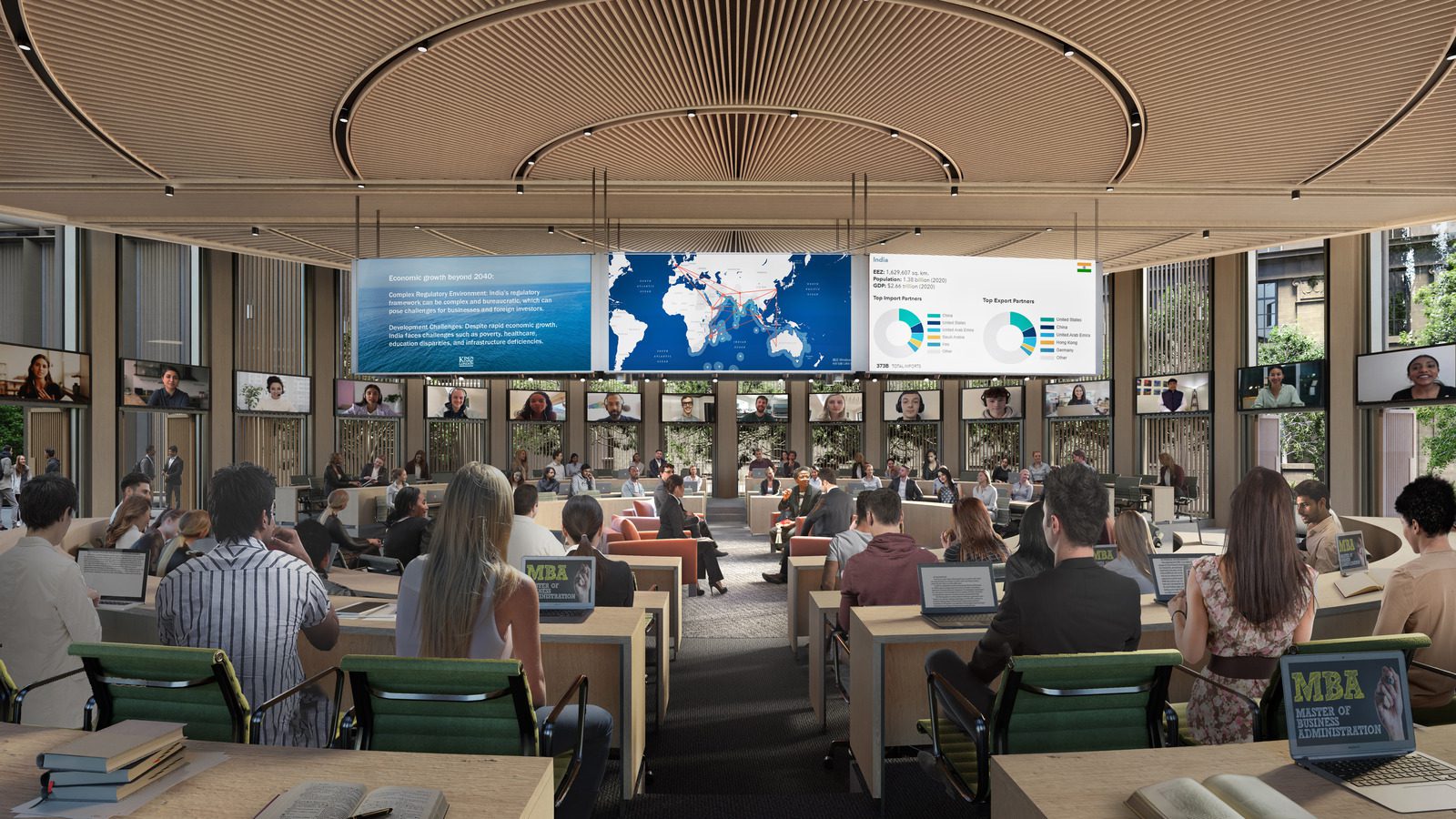
KCL Bush House, South West Wing - © ATChain
Mark Spence, Senior Director of Strategic Infrastructure & Capital Projects at King’s College London, commented “At King’s, our estate strategy is focused on enabling world-class outcomes while working within the constraints of a historic estate. Bush House South West Wing reflects that approach. It is about making one of our key assets work harder by creating modern teaching, student services, social and event spaces that support the evolving needs of the university and improve the experience of studying and working on the Strand.”
Sustainability within available spend
Net zero remains a priority for higher education, but the route to delivery is becoming more pragmatic. As capital plans have tightened, many institutions are having to reconsider the pace, phasing and affordability of their sustainability commitments.
This is not a retreat from ambition. It is a recognition that sustainability must be delivered alongside other estate priorities, including student experience, accessibility, infrastructure resilience and affordability. The most effective plans are therefore those that identify the interventions with the clearest carbon, cost and operational benefit, and then sequence them in a way the institution can realistically fund.
Infrastructure is central to this. Substations, heating systems, cooling, controls, fabric performance and energy management may be less visible than new buildings, but they often determine whether wider decarbonisation ambitions are achievable. Universities need to understand these constraints early, particularly where electrification or major plant replacement is part of the long-term plan.
Deep retrofit will remain important, but it is not always the immediate answer. In some cases, the best value may come from targeted upgrades, improved controls, plant replacement or better utilisation of existing buildings. The key is to test options carefully and avoid assuming that the most ambitious technical solution is always the most effective investment.
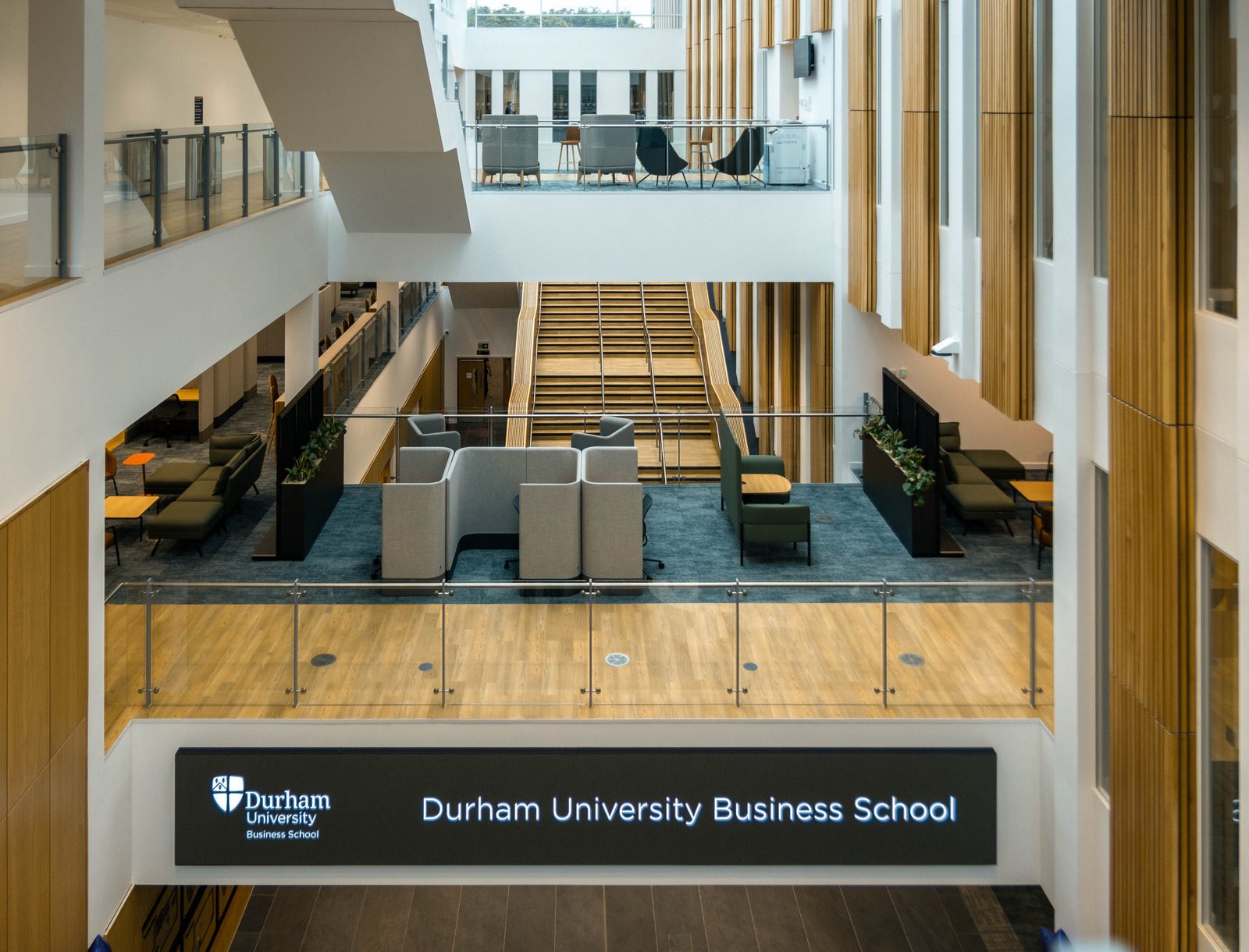
Durham University Business School demonstrates how an existing asset can be transformed to deliver improved performance within practical constraints. It provides a useful reference point for institutions seeking to balance sustainability, quality and affordability, particularly where the answer is not simply to start again.
How G&T helps
The challenge for universities is not defining ambition. It is translating ambition into programmes that are deliverable, financially viable and operationally effective in a market where every decision is subject to greater scrutiny.
G&T supports universities and research institutions by bringing cost, programme, procurement and delivery insight into the early stages of estate decision-making. We help clients test options before commitments are made, understand the implications of different routes and prioritise investment where it will create the greatest value.
Our experience spans major research facilities, specialist academic buildings, campus improvement programmes, infrastructure upgrades, public realm, adaptive reuse and sustainability-led retrofit. We also work across commercial, residential and infrastructure sectors, giving us a broader perspective on mixed-use opportunities, alternative models and investor expectations.
We support clients by:
- Prioritising capital spend across competing estate needs
- Testing options, phasing and affordability at an early stage
- Aligning cost, programme, risk and long-term performance
- Assessing the most effective interventions for existing assets
- Supporting business cases for teaching, research and student experience
- Integrating sustainability and decarbonisation into practical delivery plans
- Providing confidence through established procurement routes and framework access
High-performance estates will not be defined by scale alone. They will be defined by the quality of the decisions behind them: what is prioritised, what is phased, what is adapted and what is delivered. For universities, that discipline is becoming central to long-term success.


