



Building Insights: Redefining Conference Floor Capabilities
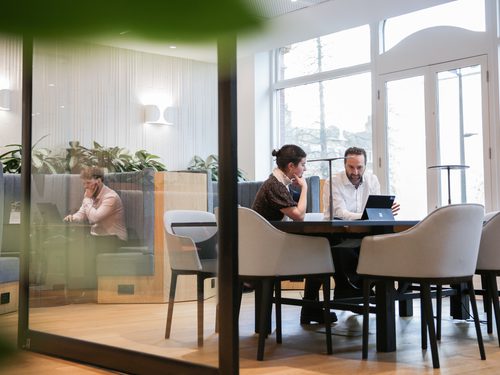
Flexible conference floors are now strategic assets for top law firms—blending boardrooms, event venues, and branded hospitality through movable partitions, integrated catering, and curated art programs.
By Charlotte Weseley, Associate Director, and Robinson Trimble, Associate Partner
Walk into a top-tier law firm today and you are just as likely to step off the elevator into something that feels closer to a hospitality environment than a traditional office floor. The reception area feels intentional rather than transactional, and the space can easily host a board meeting during the day, or a cocktail reception later that evening.
The dedicated conference floor itself is not a new concept. What has changed is the level of ambition behind it, and the expectations firms now place on how that space performs.
Flexibility is no longer a feature. It’s the foundation.
The firms we’re working with are not designing for a single use case. They are designing for constant reinvention. Movable partition systems like fully retractable Skyfold partitions allow reception areas and multipurpose rooms to operate as one continuous venue or split into distinct zones within minutes. One moment, it is a 40-person boardroom. The next, it is an open event space.
On a recent Gardiner & Theobald project spanning multiple floors, the conference level was rethought to support events that would have required off-site venues just a few years ago. That shift does not always show up in initial construction conversations, but it becomes clear over time. It reduces external spend, simplifies logistics, and brings more of the client experience in-house.
These floors are not sitting idle between events. During the day, they function as active work environments, serving teams and clients alike. By evening or weekend, the same space transforms into a branded venue without the friction of coordinating off-site.
Catering has moved from amenity to infrastructure.
What used to be an afterthought is now a fully integrated system. We are seeing induction cooking units embedded beneath stone countertops that remain invisible until activated, yet they can support full hot-food service without the clutter of traditional setups.
On the front-of-house side, the level of scrutiny feels entirely on brand for a profession known for its attention to detail. Coffee programs are decided via structured tastings, comparing beans, and evaluating machines – decisions being made the same rigor they would apply to selecting a contractor.
Coffee machine selection comes up on nearly every project, and certain patterns are emerging. De Jong has become a consistent preference among our clients, largely due to the flexibility of configurations within a single system. On one recent project, we piloted different machines across two floors during a phased restack. Employees from floors still under construction made the trip just to use them. When people start going out of their way for the coffee, it’s a clear sign those details are landing.
Milk options, bean sourcing, and brew strength may seem like small decisions, but they often generate the most feedback after occupancy. Getting them right early avoids a surprising amount of downstream friction.
Art is becoming part of the strategy, not just the décor.
The most thoughtfully executed conference floors are not simply furnished; they are curated. Firms are moving away from catalog selections and toward commissioned work, guided by art consultants who help establish internal committees, define a point of view, and connect with artists whose work aligns with the firm’s identity.
The specifics vary. Some firms prioritize local artists, while others emphasize global reach or diversity of perspective. The underlying process, however, is consistent and increasingly deliberate.
Timing plays a critical role. We typically begin the art program in concert with design so there is clear integration with art and architecture. That window reflects the realities of artist availability, exhibition cycles, and major events such as Art Basel Miami and The Armory Show in New York. These events shape artist schedules and lead times more than most clients expect. Leave it too late and the options narrow quickly, often leading to rushed commissions or temporary placeholders. Neither supports the impression these spaces are meant to make.
On a recent project, we commissioned a piece for the reception area above the main seating group. The morning after turnover, the client called not to discuss punch lists or finishes, but to talk about how much they loved the artwork. That is the difference between a space that is complete and one that resonates.
What this means for the fit-out
A high-performing conference floor requires a different level of coordination than a typical practice floor. Catering infrastructure, AV integration, movable partitions, furniture, and art consulting are all interdependent. Sequencing matters.
More importantly, it requires clarity early in the process. The most successful projects start with a clear understanding of how the space will actually be used throughout the day and into the evening before a single wall is drawn or partition specified.
For firms approaching a lease renewal or planning a full restack, the conference floor is no longer a secondary consideration. It is a strategic asset. Its value is defined not just by how it looks on day one, but by how effectively it performs over time.
The firms getting it right are not just building space. They are building capability.
Charlotte Weseley is an Associate Director at Gardiner & Theobald specializing in commercial interiors and law firm fit-outs. Robinson Trimble is an Associate Partner at G&T with extensive experience in workplace transformation for professional services clients. To discuss your next project, reach out to Charlotte or Robin directly.